Are India’s Schools In Sync With Their Students?
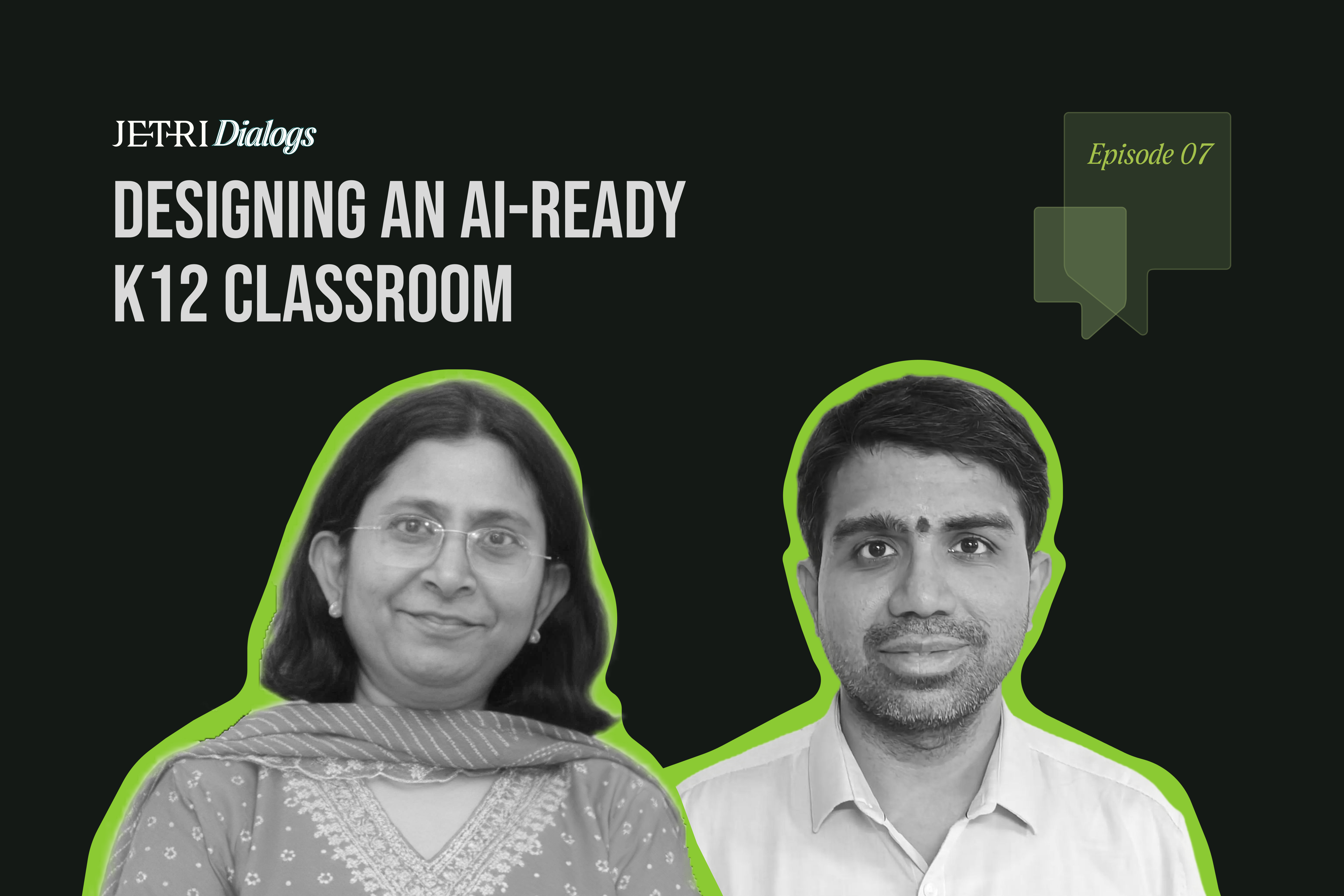
There’s a widening gap between how adults think school feels and how students actually experience it. This episode of Jetri Dialogues launches The Student Sync Index 2026 and explores what the findings mean for the future of schooling.
India’s best private schools pride themselves on being student-centred. But what if students don’t feel the same way?
That uncomfortable question sits at the heart of Jetri’s Student Sync Index 2026 - a national study capturing voices from 3,000+ students, parents, teachers, administrators, and school leaders across India’s premium K–12 schools.
For this episode of Jetri Dialogs, we are joined by Vikas Pota, Founder & CEO, T4 Education; Dr Tristha Ramamurthy, Founder, Ekya Schools, and Kanak Gupta, Director, Seth M.R. Jaipuria Schools to unpack what the report’s findings reveal about the future of school education in India.
“31% of students don’t find school time useful.” What are they really saying?
One of the most striking numbers in the Student Sync Index is also the hardest to ignore:
Nearly one in three students say they don’t find their school time useful at all.
For many educators, this feels alarming. But for the panel, it wasn’t surprising. For Tristha Ramamurthy,
“That number doesn’t surprise me. In fact, I’d expect it to be higher. Schools are dynamic environments. What children need emotionally, socially, cognitively - this keeps changing. Schools struggle to keep pace.”
Kanak Gupta who runs nearly 60 schools across Tier 2 and Tier 3 cities, echoed the concern. But he framed it as a wake-up call rather than a shock:
“If the most important stakeholder, which is the child, which is the student, which is the center of our being, does not find value in what we are doing, then definitely an alarming number… This has nothing to do with AI or access. It’s about how educators are conditioned. We need a reset on purpose.”
Is this uniquely Indian?
According to Vikas Pota, no. Global research shows a familiar pattern:
- ~75% of students are engaged in primary school
- Engagement collapses to ~25% by high school
The culprit? Relevance.
“Unless learning connects to the real world students see around them, many switch off.
The insight:
Schools that succeed across geographies are the ones where the gap between what adults design and what students experience is smallest.
If extracurriculars are meant to drive engagement, why do students find them hollow?
Engagement lives outside the classroom, right? But the data complicates that belief.
- 77% of students participate in extracurriculars
- Only 22% find them useful for engagement or skill-building
The panel agreed: extracurriculars, as currently designed, are often performative. Kanak Gupta explained:
“... academia and the extracurricular, co-curricular activities, as we generically say it, can coexist, and they can be intertwined. You cannot have them in isolation.”
In his schools:
- Academics and co-curriculars are deliberately intertwined
- Parents are oriented early to this philosophy
- Students are given agency over timetables and pathways
On the other hand, Dr Tristha Ramamurthy was clear - there is no single lever.
- Personalisation over uniform programming
- Smaller, interest-based cohorts
- Giving students choice, not just options
AI, she noted, could finally make scalable personalisation possible, but only if schools rethink control.
Both argued that experience must come before passion. Schools must intentionally design experiences that help students discover interests
The insight:
Participation ≠ agency.
Unless extracurriculars are integrated into learning—and not graded into submission—they risk becoming empty rituals.
How do you measure engagement and “real impact” in schools?
Vikas Pota’s answer came from an unusual vantage point: he created the World’s Best School Prizes during COVID after realizing that the world already has plenty of evidence on what makes a great school; yet excellence remains rare.
“The field of school improvement is very well established, actually. You know, we have enough evidence and research that talks about what makes a great school, and so the question is, if we know what works, why is it that these things don't take root?”
The prize mechanism became a structured way to surface and exchange what works at scale.
What the prizes measure (and why those categories matter)
Rather than asking schools to prove they have “engagement” or “wellbeing” in the abstract, the prizes look for evidence across five concrete improvement areas:
- Community collaboration & partnerships
- Environmental action
- Innovation (not just technology)
- Healthy living
- Overcoming adversity / building resilience
Those categories, he explained, were selected because research consistently shows they correlate with stronger outcomes and healthier school ecosystems
Engagement vs agency: Are schools overwhelming students instead of empowering them?
With packed calendars, clubs, competitions, and assessments, one audience questionstood out:
Are we building engagement at the cost of overstimulation?
Vikas Pota’s response reframed the issue entirely:
“Let me ask you first - are we talking about engagement or agency?”
According to Kanak Gupta, when schools overload calendars to signal variety or excellence, students feel pressured rather than empowered. The moment activities are graded or optimized for optics, agency collapses.
“If it is to showcase to the parents that you have multiple activities or you have marks for a lot of these activities, that is where you're overwhelming the child. When you look at it as part of personality development, personality enhancement, or simply an experience for a child, I think it absolutely works.”
The insight:
True engagement requires choice without coercion. Agency disappears when experiences are forced, quantified, or gamified for parent validation.
Why does school culture matter more than curriculum and why is it so hard to build?
Across the conversation, one theme kept resurfacing: culture precedes everything.
Before engagement, agency, reform - there is school climate. Dr Tristha Ramamurthy led with:
"I start with the feeling of how would we like our children to feel”
But culture doesn’t emerge accidentally. Her schools use culture toolkits and student-defined social contracts to ensure that values are lived. It is:
- Designed deliberately
- Measured constantly
- Reinforced daily through rituals, norms, and social contracts
Vikas Pota shared that leadership and culture consistently outperform infrastructure or curriculum as predictors of excellence. It is also the hardest thing to rank and the easiest thing to ignore.
The insight:
Culture is the invisible curriculum. And it’s far harder to copy than infrastructure, syllabi, or rankings.
Why are students motivated by marks?
The Index revealed an uncomfortable truth:
- 67% of students say the purpose of school is college admissions
- 59% say marks define success
- Only 2% cite real-life learning as motivating</aside>
This mindset is internalised. And the host, Shreyasi Singh, questioned exactly that:
“Is this just an outcome for the next career phase, which is college admissions? Is this really where all high-quality schools and all our best philosophies come to die?”
From his experience in the field, Vikas Pota shared his point of view:
“I think the more important thing to focus on is purpose-driven education - the link between what happens in schools and what's happening out there in society.”
Kanak Gupta offered a long-view perspective:
“I keep using the word conditioning because if you walk into any of our schools, you see a lot of agency in the students. And we've seen that students who've been with us right from the start their understanding of how the world functions, what they want from life, is very different to students who would have joined us in later grades.”
He also added, when they first introduced these ideas, they were often laughed at and dismissed as ‘softer’ aspects of education. Yet he sustained his commitment to building a culture of lifelong learning, fostering student agency, and grounding it in culture. That commitment has paid off, with its impact becoming visible over time.
The insight:
Marks dominate because the system rewards them. Purpose emerges only when schools consistently condition for it, over years.
Students are stressed. Parents think they’re fine. Why the disconnect?
One of the sharpest misalignments in the report sits around emotional safety:
- 57% of students feel stressed weekly
- 19% feel stressed daily
- Only 2% feel very comfortable approaching teachers
- 42% of parents believe children are immune to peer pressure</aside>
This is student-adult misalignment in its rawest form. This gap, the panel agreed, stems from limited parent engagement beyond formal touchpoints.
The insight:
Parents aren’t indifferent. They’re disconnected from the daily emotional realities of school.
Can schools ever ignore marks and admissions?
Short answer: no.
But that’s not the right question. As Dr Tristha Ramamurthy pointed out - it’s not that simple:
“I wouldn't say marks, I would say rigor, and rigor is always important, and schools need to focus on building rigor.”
Parents today are changing:
- Family ethos is evolving
- Homeschooling numbers have gone up
- More open to modern alternatives
“Most parents, they might have come from the IITs and IIMs, say - I just want my child to be a good citizen, to do something good.“
The Insight:
The challenge isn’t abandoning rigor—it’s redefining it.
As families evolve and the future of higher education becomes less predictable, schools must balance structure and discipline with freedom and meaning.
Why do parents trust rankings?
Parents overwhelmingly trust:
- Brand
- Board
- Rankings
Yet only 33% of students believe their school offers something meaningfully better than others. This gap exists because parents engage episodically (PTMs) but want influence continuously.
Kanak Gupta was clear on it:
“You need to engage parents all year round, right from the entry level… If you engage and involve them only during the PTMs. Then they don't have much understanding as to what you are doing, and the agency towards it as well.”
His schools prioritise:
- Deep onboarding conversations
- Ongoing communication
- Treating parents as partners, not customers
Vikas Pota added a global lens:
“I think the best indicator, even from my own experience as a parent, is where kids want to go. Because they engage students with meaningful, real-world learnings, support their well-being, and promote a strong sense of community and responsibility.”
The insight:
Reputation is a proxy for trust. But lived experience is the real audit.
The changes schools know they need but avoid
When asked what schools hesitate to fix, the answers were telling:
- Kanak Gupta: Free teachers from administrative overload.
- Dr Tristha Ramamurthy: Protect, respect, and celebrate teachers as professionals.
- Vikas Pota: Give principals real autonomy.
The insight:
All three point to the same truth: Student experience cannot improve without changing how adults work.
If schools could redesign one thing for the next decade, what should it be?
The answers converged:
- Vikas Pota: Over-invest in daily teacher development
- Kanak Gupta: Build schools that listen more than they talk
- Dr Tristha Ramamurthy: Focus on people, not systems
The insight:
Student experience cannot improve unless adult learning accelerates.
Can schools really change parent mindsets?
An audience question surfaced a hard truth:
How effectively are you able to help parents move beyond perceived notions of quality education, especially when such perceptions result in demands that conflict with the core idea of learning? How real is the threat of parents exercising school choice if their needs are not pandered to?
Dr Tristha Ramamurthy explained that misalignment rarely appears overnight. If a parent fundamentally doesn’t align with a school’s ethos, the problem is already too late to solve in one meeting.
“I think if it comes to the very end, there's way little to be done, but there's a lot to be done before that, and parents are understanding, and they really can see value when you have those conversations.”
Kanak Gupta echoed this, calling late-stage change “near impossible” if parents are already rigid in their expectations. However, parents aren’t forming perceptions in isolation. In schooling, society is an invisible stakeholder.
“Word of mouth is very important in schooling. As to, you know, the perception of the parent comes a lot from their peers as well. So, society being a very important stakeholder is there. You need to have your voice going out as well.”
The Insight:
Schools can’t appease every parent. They can only attract and retain those who align with their purpose.
If the obsession with the “Next Step” Is the problem, what’s the alternative?
Another audience member raised a deeper concern:
If focusing on the next step is an issue, how can we differentiate the crazy focus on meeting the needs of the higher education entry requirements?
Speaking as both a school leader and university provost, Dr Tristha Ramamurthy shared her views:
“I'm generally very optimistic for India and the India story. I think higher education is seeing a sea change, the kind of universities that are being built, will no longer need the same kind of entry requirements that even currently exists.”
While India remains exam-heavy, she pointed to early shifts:
- Growing interest in commerce and humanities
- Changing job markets
- Universities rethinking admissions and learning models
“The landscape is changing, and the kind of courses that we will need and the kind of way we should prepare our students is continuing to change”
The Insight:
Schools can’t abandon rigor, but they can prepare students for a future where marks are no longer the only credible currency.
Closing thoughts
The Student Sync Index doesn’t accuse schools of failing students. It shows something more nuanced—and more urgent: Schools are trying to be student-centred using adult assumptions.
So, are India’s schools In sync?
The answer isn’t binary.
India has:
- Exceptional schools
- Deeply committed educators
- Strong foundations of safety and structure</aside>
But it also has:
- Misread student realities
- Over-indexed reputation signals
- Under-designed student agency</aside>
The work ahead is about closing the gap between intention and experience; with honesty, humility, and sustained cultural change.
As India reimagines what schooling should prepare young people for, student sync may be the most important metric we haven’t been measuring until now.

.jpg)
Subscribe to Jetri Dialogs
Get updates about upcoming episodes and
on-demand learning - straight to your inbox.